
We built the technology. We structured the legal framework. The asset was real, the yield was compelling, and the infrastructure was ready. And then we learned that none of that was the actual problem. The problem was something harder to build, and far more important to understand if you’re serious about unlocking emerging market capital at scale.
Technology moves assets. Trust makes them investable.
And I said the answer was one word: Trust.
I want to be specific about what that means. Not abstract. Not theoretical. I’ve watched it fail in practice. Then I watched it work. And the difference between those two outcomes taught me more about the real architecture of global capital than any academic framework could.
The pilot that almost worked.
We ran one of the first structured tokenization pilots in the Western Balkans. The asset was real, a legitimate real estate project with verified underlying value, developed by people who had delivered before. The financial structure was sound. The legal documentation was complete. The token infrastructure was operational. By every technical and structural measure, the deal was ready.
Foreign capital didn’t come.
And for a while, this was genuinely confusing. We had done what the industry said was needed. We had removed the friction. We had made the investment accessible, digital, and borderless. The efficiency argument for tokenization was fully realized in this deal.
Efficiency was not the problem.
When we spoke to prospective investors, diaspora capital, European family offices, and regional wealth, the questions were not about the technology. They weren’t asking how the token worked. They were asking:
Who is the asset manager? What’s their track record? Where is the independent valuation? Who audits the financials? What happens if projections aren’t met? How do I enforce this across borders?
We had answers to some of those questions. But not all of them. And in cross-border capital markets, partial answers are the same as no answers. The investment didn’t happen. What we had built was a fast, efficient, transparent mechanism for transferring value. What we had not built, and what we learned we needed to build first, was a reason to believe the value was worth transferring toward.
Blockchain has abstracted the cost of moving value across borders to near zero. It has not abstracted the cost of establishing that the destination is worth trusting.
The irony that keeps me up at night.
I lived through the ICO era. I was in crypto when anonymous teams with no track record, no legal structure, and no accountability raised tens of millions of dollars in days. Projects that had nothing but a white paper and a Telegram group. Capital that vanished without a product being delivered, without a single recourse mechanism in place. I watched that happen repeatedly, and then I watched something that still feels absurd to me: a real estate developer with ten years of delivered projects, audited financials, physical assets you can walk through, a regulated legal structure, and a verifiable yield, couldn’t raise €5 million from foreign investors.
| Crypto ICO · 2017–2021 | EM Real Estate Developer · 2024 |
| Anonymous team. No legal entity. No audited financials. No track record. No product. White paper + Telegram group. Raised millions in days. No accountability when it failed. | Ten years of delivered projects. Physical, walkable assets. Regulated legal structure. Audited returns. Real yield. Cannot raise €5M from foreign investors without 18 months of trust-building infrastructure. |
This is not a technology problem. This is not a regulatory problem. This is a trust problem, and it runs much deeper than the industry acknowledges. The ICO raised money because, perversely, crypto had already built a kind of trust: the trust that the blockchain itself would enforce the transaction. The token would arrive. The mechanism was trustless, mathematically guaranteed. Nobody needed to trust the team because the code was transparent and the delivery was automatic, and somehow everyone would multiply their money.
Real-world assets cannot work that way. A tokenized real estate project requires you to trust that the underlying asset exists as described, that the manager will operate it competently, that the reported returns are accurate, and that enforceable recourse exists if they aren’t. None of that is encoded in the token. All of that has to be built around it.
Blockchain reduced the cost of transacting. It did not reduce the cost of trusting what moved in it.
The Trump comparison is worth sitting with.
Consider two hypothetical investment opportunities: identical asset class, identical yield projections, identical market.
One is presented by an emerging market developer you’ve never heard of. The other is the WLFI deal, Trump International Hotel & Resort in the Maldives, with a name that carries global recognition across dozens of markets. In many emerging economies, the Trump brand carries more institutional weight. The name is a heuristic for established wealth, and for a legal and reputational infrastructure that makes an exit at least theoretically enforceable.
That differential, everything else being equal, determines whether capital moves. Not yield. Not technology. Not legal structure. The answer to the question “do I trust this?” is almost entirely determined by prior knowledge of the counterparty.
Emerging market asset managers are competing for global capital against counterparties who have decades of brand recognition, institutional relationships, and documented track records. A developer in Tirana or Nairobi or Jakarta — even with a superior asset and a higher yield — starts every conversation from a trust deficit that no technology can close.
This is the real infrastructure gap. Not rails. Not regulation. Track record.
And it compounds. The less access a market has to foreign capital, the fewer foreign investors build familiarity with that market’s assets. The fewer investors who build familiarity, the lower the trust baseline. The lower the trust baseline, the harder it is to raise capital. The system self-reinforces its own exclusion.
The allocator data is not ambiguous.
This isn’t only about individual deals. It shows up in aggregate portfolio behavior.
Emerging markets represent 80% of global GDP growth and roughly 90% of the world’s population. They hold approximately $10 trillion in listed equities alone. And yet global active managers have reduced their EM exposure, from 13% of portfolios in 2020 to below 10% in 2023. About 80% of international investment products are underweight emerging markets by an average of 28%.
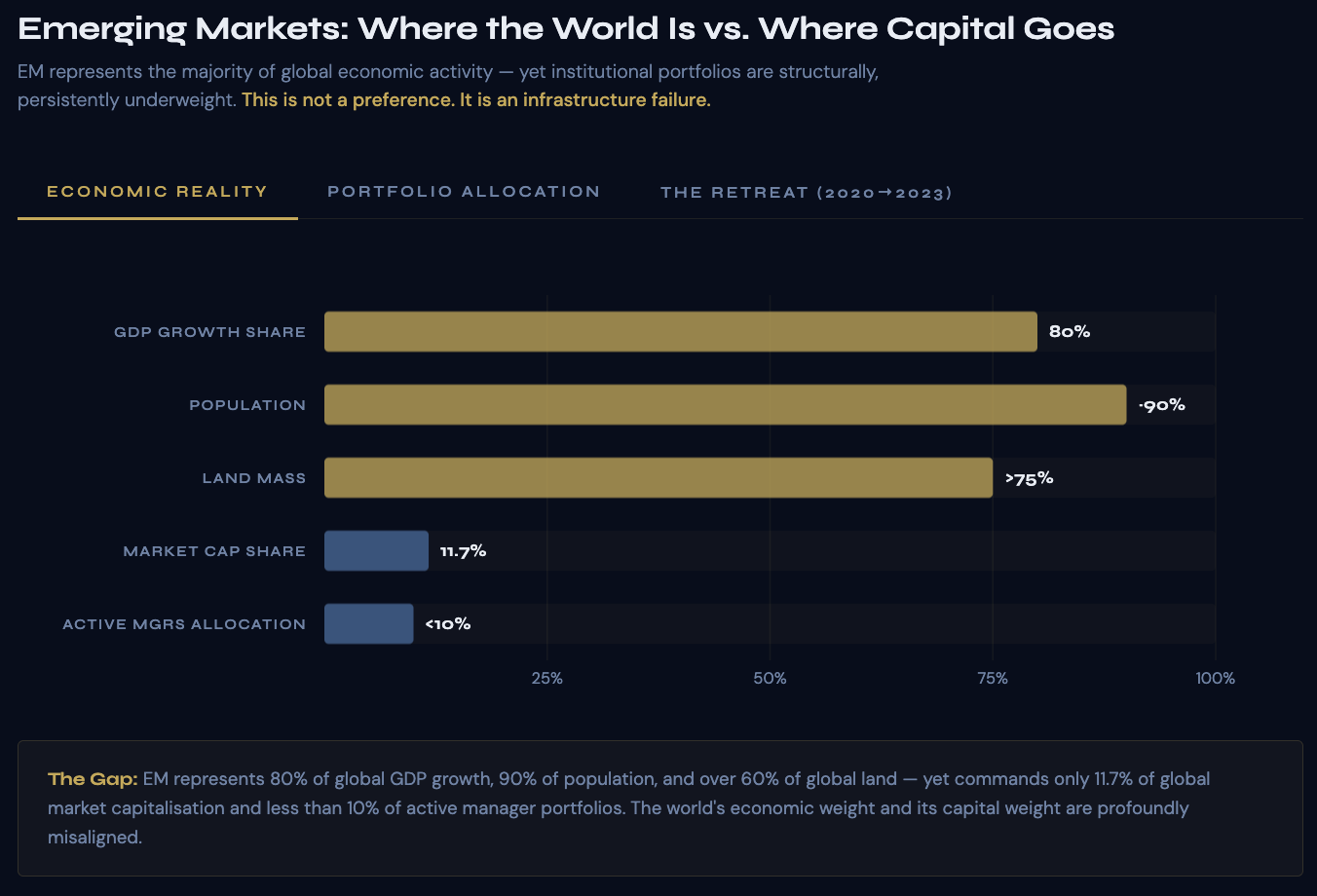
This is not a yield story. The yield in EM — 15–30% in real estate and infrastructure in many of these markets vastly outpaces what’s available in Western money markets. If this were a pure return optimization problem, capital would already be flowing.
It isn’t flowing because the trust infrastructure required to evaluate, commit to, and monitor an emerging market asset doesn’t exist at institutional grade for most of these assets. The allocation gap is a trust gap.
What we learned: trust has a structure.
After the pilot didn’t work, we rebuilt our approach from the ground up. Not around the technology. Around the trust architecture.
The insight was this: you cannot manufacture the kind of trust that comes from a decade of institutional track record. But you can borrow it. You can plug into jurisdictions and structures that already carry credibility with international investors, and use that borrowed credibility to create the trust layer that a first-time emerging market issuer cannot generate on its own.
The sweet spot turned out to be the diaspora. High-net-worth individuals who had built capital in the West but maintained deep ties — family, property, business — to their countries of origin. They wanted exposure. They understood the asset. They had the emotional context that informed their risk judgment. And they lacked any compliant, institutional instrument through which to deploy capital back home.
This wasn’t a concession. It was a discovery. The diaspora investor is the natural first capital for emerging market tokenization: motivated by connection, sophisticated enough to evaluate the asset, and underserved by every existing product in the market.
The technology was exactly the same as the failed pilot. The asset quality was comparable. The yield was similar. The difference was the trust architecture around it. And that architecture is not free.
Trust engineering has a real cost. That’s the point.
This is the part of the emerging markets opportunity that most tokenization platforms don’t want to talk about, because it complicates the narrative of frictionless capital.
Building a trust layer around an emerging market asset requires: structuring in a recognized cross-border jurisdiction such as Luxembourg, Netherlands, or Singapore, where institutional investors already know how to evaluate. Drafting enforceable term sheets under a legal framework that professional investors can audit. Establishing independent valuation through credentialed third-party appraisers. Engaging Big 4 auditing or equivalent to verify financials and track record. Creating governance structures that give investors real recourse in the event of underperformance.
This is necessary friction. Not inefficiency — necessary friction. It is the functional equivalent of the proof-of-work that makes a blockchain secure: computationally expensive on purpose, because the cost is what creates the guarantee.
Blockchain solved the problem of trustless transactions. The remaining problem — the harder one — is trusted assets. And the cost of manufacturing trust around an asset is not going to zero anytime soon.
The ICO era got away without this cost because crypto markets had invented a product where the underlying mechanism was the asset. There was nothing to audit beneath the token, because the token was the thing itself. Real-world assets don’t have that luxury. The token is a claim on something that exists in physical reality, and physical reality requires human verification, legal accountability, and institutional structure.
This is why the low-hanging fruit in the EM tokenization wave is not individual projects. It is listed equities, assets with public price discovery, exchange-listed transparency, regulatory oversight, and years of documented performance. And after that, established private funds managed by operators who already have the credibility, the audit trail, and the institutional relationships that the trust architecture requires.
The three-tier trust architecture.
What we’ve built, and what this market will build, is a sequenced approach to trust. You don’t start with the highest-yield opportunity. You start with the highest-trust opportunity, and you use it to build the credibility infrastructure for everything that follows.
| Tier | Asset Type | Trust Source | Yield Profile |
|---|---|---|---|
| TIER 1 | Listed Equities | Market-proven. Public price discovery, exchange-regulated, years of audited performance. Trust already exists. The infrastructure is the missing piece. | Market-rate. First mover advantage for the infrastructure provider. |
| TIER 2 | Established Private Funds (RE, Infrastructure, Renewables, VC) | Structure-borrowed. Luxembourg securitisation vehicle. Third-party auditing. Credentialed fund managers with track records. Trust is engineered through jurisdiction and governance. | 15–25% in select emerging markets. |
| TIER 3 | Qualified Individual Projects | Curated trust. Deep issuer vetting, ring-fenced structures, verified documentation, third-party accountability at every layer. Highest yield — highest cost of trust engineering. | 25–30%+ returns. Early-stage positions: 2–3× capital. |
The sequencing is the strategy. You start at Tier 1, not because the returns are highest, but because the trust is already established. You use the track record and the platform credibility built in Tier 1 to unlock Tier 2. You use Tier 2 to build the institutional relationships and documentation infrastructure that qualifies Tier 3. Each tier is a proof point for the next. Each successful transaction adds to the credibility stack that makes the subsequent one easier to close.
Why this matters beyond the deal level.
The capital markets in emerging economies are not going to be unlocked by better technology. They are going to be unlocked by a new class of infrastructure that bridges the trust gap, not by eliminating it, but by engineering around it systematically.
Professional institutional capital, the family offices, the asset managers, and the private banks will follow the track record. Not because they were waiting for blockchain. Because they were waiting for accountability structures they could evaluate with their existing frameworks. That accountability structure is being built now. And once it exists at scale, the $10 trillion that sits disconnected from the global capital markets, the listed equities, the private funds, the infrastructure projects across Latin America, Southeast Asia, the GCC, and Africa, becomes accessible not as a speculative bet, but as an institutional asset class.
The internet didn’t unlock commerce by eliminating the need for contracts, delivery verification, and consumer protection. It unlocked commerce by building the infrastructure that made those things work across borders. The same logic applies here.