
Not every asset that is valuable is investable. This article breaks down the six criteria every asset must meet before professional international capital can move toward it, and why most emerging market assets fall short not on quality, but on architecture.
Every year, billions of euros in real, yield-generating assets across Southeast Europe, the Gulf, Africa, and Latin America fail to attract international capital. The assets are real. The returns are competitive. The developers and asset managers behind them are often experienced operators with verified track records.
The capital still does not come.
The reason is rarely the asset itself. It is the absence of the architecture around it. International professional capital does not evaluate assets in isolation; it evaluates assets inside a framework. If that framework is absent or incomplete, the asset is not evaluated at all. It is filtered out before the first conversation.
Valuable and investable are not the same thing. The gap between them is not returns, track record, or asset quality. It is the infrastructure of trust that professional capital requires before it can allocate.
In the Finance 2.0 series, we have argued that trust in capital markets is not a feeling; it is an architecture.
It is built from specific, verifiable components that allow an investment committee, a risk officer, a compliance team, and a legal counsel to each answer their specific question about an asset without ambiguity. This article defines what those components are.
Why Good Assets Get Rejected
There is a pattern that repeats itself in emerging markets with striking consistency. A developer presents a completed, income-generating asset, such as hotels, real estate portfolios, or renewable energy infrastructure, with a decade of delivered projects behind them. They are refused by foreign investors not because the asset underperforms, but because the foreign investor’s compliance team cannot process what they are being shown.
During the ICO era, this contrast became impossible to ignore. Anonymous teams with unaudited white papers and zero delivered assets raised hundreds of millions in weeks. Verified developers with real assets, real cash flows, and real governance structures could not raise €5M from a professional foreign investor. The blockchain did not discriminate. The trust architecture, or rather the complete absence of it, did.
The international capital allocation process is governed by frameworks, not impressions. An investment committee needs a structured instrument it can underwrite. A risk officer needs a valuation they can defend. A compliance team needs a legal wrapper that they have seen before. An operations team needs a custody arrangement that connects to their existing infrastructure. None of these questions is answered by the quality of the asset alone.
| A Valuable Asset Has | An Investable Asset Also Requires |
|---|---|
Strong yield potential | Recognised jurisdiction & legal vehicle |
| Real, physical underlying asset | International-standard audited financials |
Experienced developer or sponsor | Enforceable investor documentation |
Local track record of delivery | Independent third-party valuation |
Competitive risk-adjusted returns | Documented governance structure |
Active domestic market demand | Regulatory-compatible instrument format |
The Six Layers: A Practical Framework
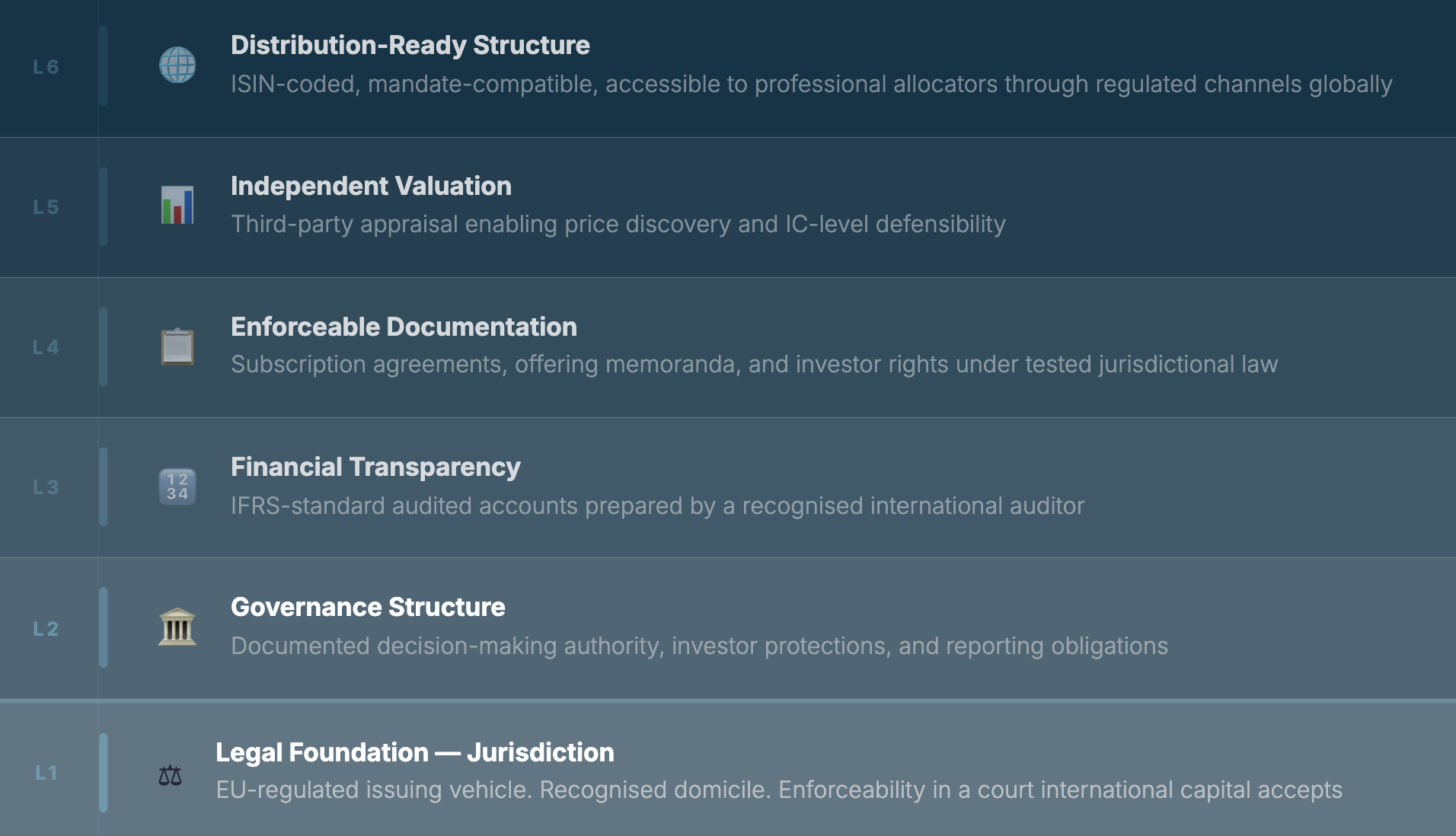
Before T-Blocks structures any deal, every asset passes through six questions. Not sequentially, simultaneously. An investment committee, a risk officer, a compliance team, and an operations desk each ask their question in parallel, and each question maps to one of these layers. If any layer is absent, the process stops, not because the other layers are weak, but because the framework requires all six to be present at once.
What follows is a practical guide to what each layer requires, and what failure at that layer looks like in practice.
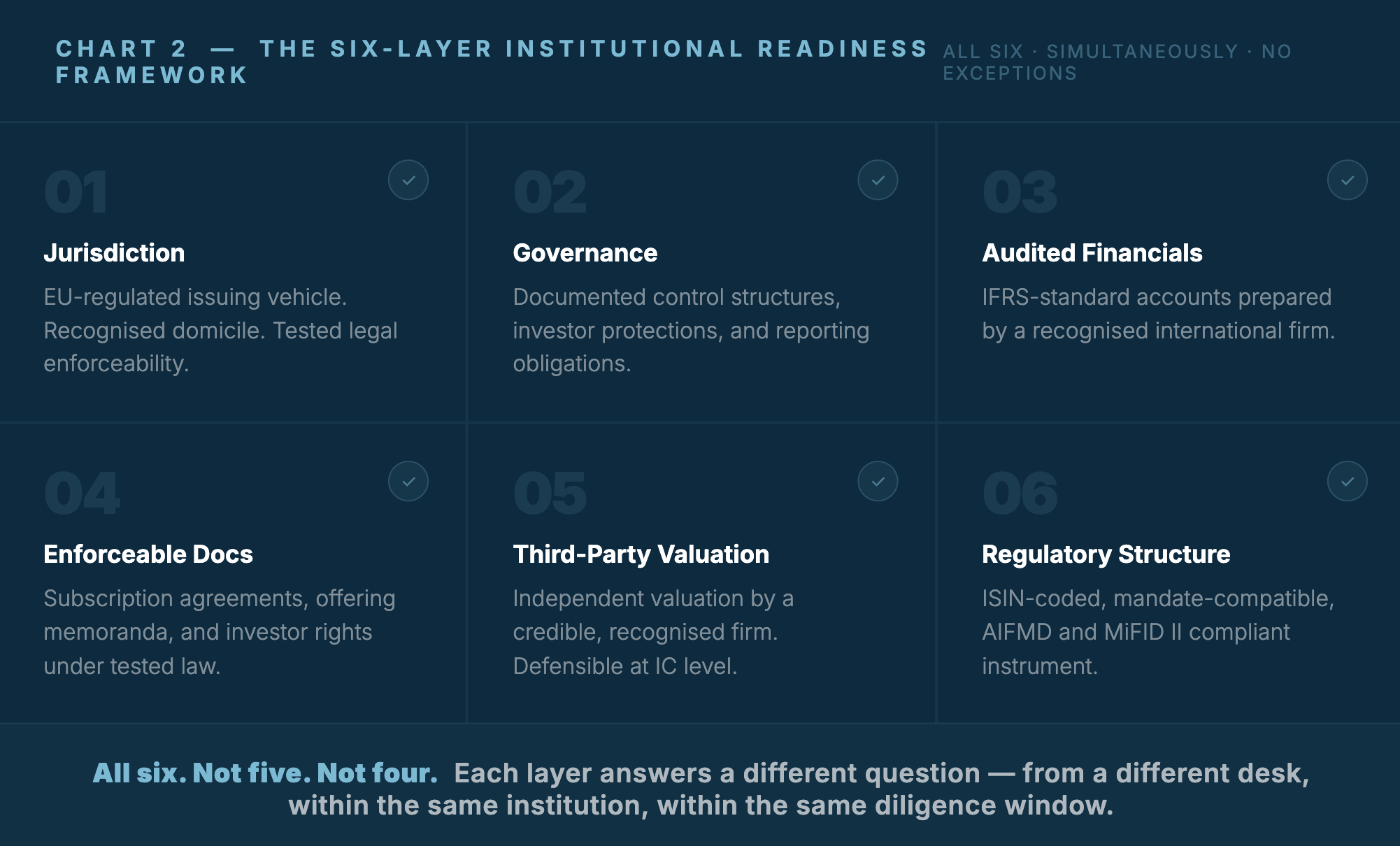
- Jurisdiction (Legal Foundation) The domicile of the issuing vehicle determines whether the instrument is recognisable to an allocator’s legal and compliance team. A Luxembourg-domiciled SPV signals EU regulatory standards, investor protections, tax neutrality, and judicial enforceability — all of which an allocator’s team has encountered before and knows how to process.
Failure: A local entity in an unrecognised jurisdiction forces the allocator’s legal team to build a bespoke legal opinion. Most mandates do not budget for this. The asset is excluded before analysis begins. - Governance (Investor Protection): Who controls the asset, under what rules, and with what protections for investors? Board composition, decision-making authority, minority rights, reporting obligations, and conflict-of-interest protocols must all be documented. Governance is not about distrust of the manager; it is what makes trust transferable to a counterparty who has never met them.
Failure: Informal control structures, where decisions rest with a founder without documented checks, are unacceptable to institutional mandates. There is nothing to review, and therefore nothing to approve. - Audited Financials (Most Common Gap) Not management accounts. Not a summary prepared for a bank loan. International-standard audited financials, IFRS or equivalent, prepared by a firm whose name an allocator’s compliance team recognises. This is the single most common gap in emerging-market issuers. Local accounts prepared under domestic standards are not a substitute, regardless of their accuracy.
Failure: Unaudited or locally-standard accounts cannot be independently verified by an international allocator. The financial case for the asset, however strong, cannot be confirmed, which means it cannot be presented to an IC. - Enforceable Documentation (Legal Clarity) Subscription agreements, offering memoranda, custody arrangements, investor rights schedules, and exit mechanisms, all drafted under a jurisdiction with clear and tested contract enforcement. The question an allocator’s legal team asks is specific: if something goes wrong, in which court, under which law, with what investor protections, and with what probability of recovery?
Failure: Informal agreements, unsigned memoranda, or documents drafted under jurisdictions with limited enforcement history leave that question unanswered. Unanswered legal questions do not get approved; they get declined. - Third-Party Valuation (Price Discovery): An independent, internationally recognised valuation of the underlying asset, not a developer’s own appraisal, and not an estimate from a local bank. A third-party report produced by a firm whose methodology and credentials an allocator can present to their investment committee and defend under scrutiny. Without an agreed price from a credible source, there is no transaction. Failure:Self-reported valuations, however reasonable, are not investable. They represent the issuer’s interest in the outcome,which is precisely why independent valuation exists. Allocators will not underwrite an asset without one.
- Regulatory-Compatible Structure (Mandate Access) The instrument must fit inside the regulatory constraints of the allocator’s mandate: asset class eligibility, geographic restrictions, AIFMD classification, MiFID II requirements, ISIN issuance, and custodian compatibility. An asset that cannot be held within an institutional mandate, regardless of how strong layers one through five are, cannot receive institutional capital. Failure: An instrument that falls outside an allocator’s mandate constraints is not declined on merit, it is structurally ineligible. No amount of negotiation changes this. The structure must be built correctly from the outset.
The Trust Architecture Connection
These six layers are not arbitrary compliance requirements. They are the components of a trust architecture, a term we introduced in the Finance 2.0 series to describe the infrastructure that makes an asset legible to professional capital.
The argument is straightforward: what institutional capital cannot verify, it cannot allocate to. Each of the six layers corresponds to a specific verification that a specific function within an institution must complete before capital can move. Jurisdiction answers the legal team’s question. Governance answers the risk officer’s question. Audited financials answer the IC’s question. Enforceable documentation answers the counsel’s question. Third-party valuation answers the portfolio manager’s question. Regulatory structure answers the compliance team’s question. When one layer is missing, one desk cannot complete its review. That desk does not forward the deal, and the process stops.
This is also why the earlier observation about blockchain matters here. As T-Blocks described in the trust architecture thread on X: blockchain made transactions trustless. It did not make assets trustworthy. The six layers are the mechanism through which asset trustworthiness is constructed, not by the chain, but by the structure around it.
What This Looks Like in Practice
T-Blocks operates an active structuring pipeline of over €670M in assets across Southeast Europe and the Gulf. Every deal in that pipeline passes through all six layers before a single investor conversation begins. This is not a compliance formality; it is the process that determines whether an asset can be presented to professional capital at all.
Consider a concrete example that represents the majority of emerging-market issuers T-Blocks encounters: a real estate developer with a completed, income-generating portfolio in a high-growth Mediterranean market. Ten years of delivered projects. Audited local accounts. Strong occupancy rates. Compelling yield relative to comparable Western assets.
What they typically have when they arrive: the asset, the track record, and the local financial history. What the six-layer framework requires them to add before international capital is accessible is the following:
Typical Structuring Requirements — Emerging Market Issuer
→ Luxembourg SPV established — issuance vehicle incorporated under EU law, providing the jurisdictional foundation required by international mandates
→ Governance framework documented — board structure, investor rights, reporting cadence, and conflict protocols formalised in the constitutional documents
→ IFRS restatement of financials — local accounts restated under international standards by a recognised auditor, enabling IC-level financial analysis
→ Offering documentation drafted — subscription agreement, information memorandum, and investor rights schedule prepared under Luxembourg law
→ Independent valuation commissioned — third-party appraisal of the underlying asset portfolio by a firm acceptable to institutional allocators
→ ISIN-coded digital security issued — instrument structured for custody, reporting, and distribution through regulated channels to professional investors
None of these steps requires the asset to change. The returns, the occupancy, and the physical reality of the development remain exactly as they were. What changes is the architecture around the asset, and that architecture is what converts a valuable asset into an investable one.
The Gap Is Architectural. Architecture Can Be Built.
Emerging and semi-emerging markets do not lack assets. They lack the infrastructure that makes those assets legible to professional capital. That gap is not ideological, and it is not permanent. It is structural, which means it can be solved by building the right structure.
The six layers described in this article are not a new framework invented by T-Blocks. They are the questions that investment committees, risk officers, compliance teams, and legal counsel have been asking for decades. What T-Blocks has built is the infrastructure that allows emerging-market issuers to answer all six of those questions, reliably, repeatably, and within a regulated EU framework that professional capital already accepts.
The result is a market opportunity that compounds: each deal structured correctly establishes a precedent, each layer built lowers the cost of the next issuance, and each successful distribution opens the next allocator relationship. This is how markets expand, not through technology alone, but through the patient construction of the architecture that makes them possible.
Complete the T-Blocks Issuer Form to give our team the information needed to evaluate your asset, identify the right legal and financial structure, and prepare an indicative term sheet aligned with your capital needs, investor profile, and distribution strategy. It is the starting point for turning a local project into an investable opportunity that can be structured for professional capital.